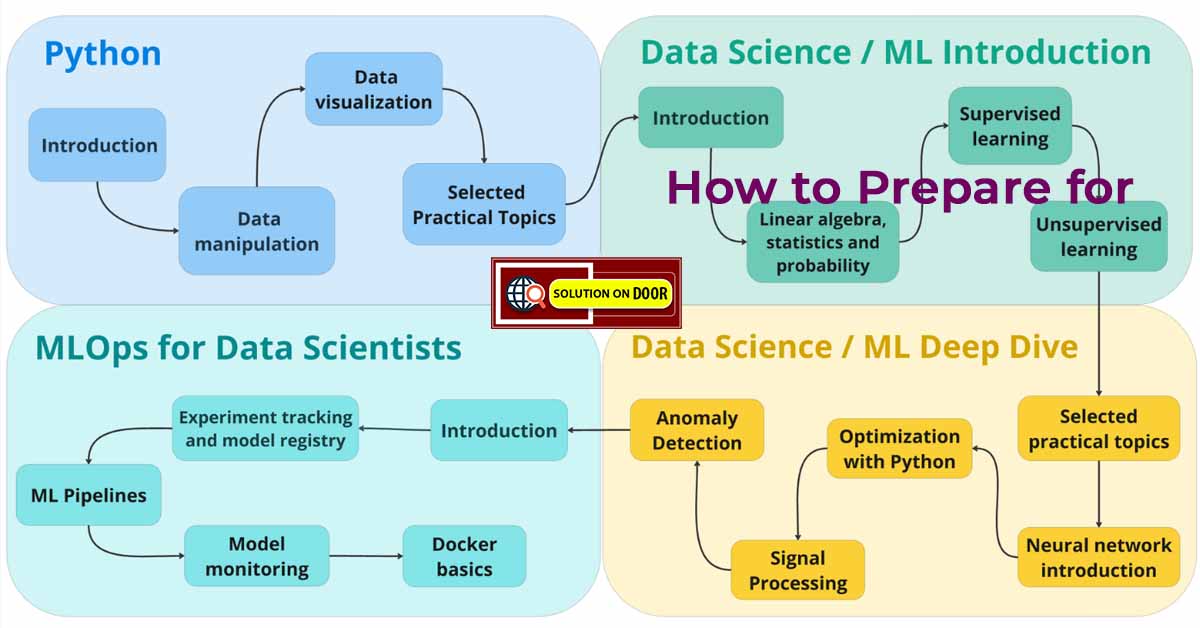
Roadmap for Machine Learning: A Complete Career Guide

πŸš€ Roadmap for Machine Learning: A Complete Career Guide (2026)

Machine Learning (ML) is one of the fastest-growing fields in technology today. From recommendation systems on Netflix to self-driving cars and AI chatbots, Machine Learning is shaping the future of industries worldwide.

If you are planning to build a career in Machine Learning, this guide will help you understand the complete roadmap, career opportunities, hiring trends, salary expectations, and how to get a job in this field.
πŸ“Œ What is Machine Learning?

Machine Learning is a branch of Artificial Intelligence (AI) that enables computers to learn from data and make decisions without being explicitly programmed. It focuses on building algorithms that improve automatically through experience.

ML is widely used in healthcare, finance, education, e-commerce, cybersecurity, and automation.

πŸ›£οΈ 1. Roadmap for Machine Learning

To become a successful Machine Learning professional, follow this step-by-step roadmap.


βœ… Step 1: Learn Mathematical Foundations

Strong fundamentals are essential for understanding ML algorithms.

You should focus on:

  1. Optimization Techniques
  2. Linear Algebra
  3. Probability & Statistics
  4. Calculus

βœ… Step 2: Master Programming Skills

Python is the most popular language for Machine Learning.

Learn:

  • Python Basics
  • NumPy & Pandas
  • Data Visualization (Matplotlib, Seaborn)
  • SQL for Data Handling

βœ… Step 3: Understand Core Machine Learning Concepts

Start with traditional ML techniques:

  1. Model Evaluation
  2. Supervised Learning
  3. Unsupervised Learning
  4. Regression & Classification
  5. Clustering

βœ… Step 4: Learn Advanced Machine Learning

After mastering basics, move to advanced topics:

  • Deep Learning
  • Neural Networks
  • Natural Language Processing (NLP)
  • Computer Vision
  • Reinforcement Learning

βœ… Step 5: Work with ML Tools & Frameworks

Practical knowledge of tools is necessary:

  • Scikit-Learn
  • TensorFlow
  • PyTorch
  • Keras
  • OpenCV
  • SpaCy & NLTK

βœ… Step 6: Build Real-World Projects

Projects prove your skills to employers.

Some project ideas:

  • Face Recognition System
  • Sales Prediction Model
  • Chatbot Application
  • Recommendation System
  • Fraud Detection System

Publish your projects on GitHub and create demos.

🎯 2. Career Options in Machine Learning

Machine Learning offers multiple career paths.

Popular Job Roles:

  • Machine Learning Engineer
  • Data Scientist
  • AI Engineer
  • NLP Engineer
  • Computer Vision Engineer
  • Research Scientist
  • MLOps Engineer

Each role requires a combination of programming, analytics, and domain knowledge.

πŸ“ˆ 3. Current Hiring Trends in Machine Learning

In 2026, Machine Learning professionals are in high demand across industries.

Top Hiring Sectors:

  • IT & Software Companies
  • FinTech & Banking
  • Healthcare & BioTech
  • E-Commerce Platforms
  • Automotive & Robotics
  • EdTech Companies
  • AI Startups

In-Demand Skills:

  • Deep Learning
  • NLP & Transformers
  • Cloud ML
  • MLOps
  • AI Deployment

Candidates with hands-on experience and deployment knowledge are preferred.


πŸ’° 4. Salary Range in Machine Learning

Salary depends on experience, skills, and location.


πŸ“ Salary in India

ExperienceAverage Salary
Fresherβ‚Ή4 – β‚Ή8 LPA
2–4 Yearsβ‚Ή8 – β‚Ή18 LPA
5+ Yearsβ‚Ή20 – β‚Ή40 LPA

🌍 Global Salary (USA/Europe)

ExperienceSalary (USD)
Entry Level$90K – $120K
Mid Level$120K – $160K
Senior Level$160K+

πŸŽ“ 5. How to Get a Job in Machine Learning?

Getting a job in ML requires strategy, practice, and consistency.


πŸ”Ή Step 1: Learn from Quality Resources

Use platforms like:

  • Coursera
  • Udemy
  • edX
  • YouTube
  • Kaggle

Focus on practical learning.


πŸ”Ή Step 2: Build a Strong Portfolio

Your portfolio should include:

  • 5–8 Quality Projects
  • GitHub Profile
  • Technical Blog (Optional)
  • Live Project Demos

This helps recruiters evaluate your skills.


πŸ”Ή Step 3: Prepare for Interviews

Prepare for:

  • ML Algorithms
  • Python Coding
  • Data Structures
  • Statistics
  • Case Studies

Practice on LeetCode, Kaggle, and HackerRank.


πŸ”Ή Step 4: Apply Smartly

Apply through:

  • LinkedIn Jobs
  • Naukri.com
  • Indeed
  • AngelList
  • Company Career Pages

Customize your resume for each job role.


πŸ”Ή Step 5: Learn Deployment & MLOps

Modern companies expect candidates to know:

  • Model Deployment
  • Docker
  • Cloud Platforms
  • CI/CD Pipelines
  • API Integration

This increases your hiring chances.


🌟 Tips for Success in Machine Learning

βœ” Learn continuously
βœ” Participate in Kaggle competitions
βœ” Follow AI researchers
βœ” Attend webinars and meetups
βœ” Build industry-relevant projects
βœ” Network on LinkedIn


πŸ“Œ Conclusion

Machine Learning is a future-proof career with excellent growth opportunities. By following the right roadmap, building strong projects, and staying updated with industry trends, you can successfully enter this exciting field.

How to Prepare for Object-Oriented Programming

How to Prepare for Object-Oriented Programming (OOP): A Roadmap for BTech Students

Object-Oriented Programming (OOP) is a fundamental concept in software development. It helps in structuring programs efficiently and is widely used in real-world applications. For BTech students, mastering OOP is crucial as it forms the base for advanced programming and development.

In this guide, we will explore a structured roadmap to learning OOP and provide information on free online platforms where you can test your knowledge.

Step-by-Step Roadmap to Master OOP

1. Understand the Basics of Programming

Before diving into OOP, ensure you have a solid understanding of basic programming concepts such as variables, loops, and functions. Recommended languages for OOP include Java, C++, Python, and C#.

2. Learn the Core OOP Principles

The four fundamental OOP principles are:

  • Encapsulation: Bundling data and methods together.
  • Inheritance: Reusing and extending existing classes.
  • Polymorphism: Using a single interface for different data types.
  • Abstraction: Hiding implementation details and showing only functionality.

3. Study Object-Oriented Programming Concepts

Key concepts to focus on:

  • Classes and Objects
  • Constructors and Destructors
  • Access Modifiers (Public, Private, Protected)
  • Static and Final Keywords
  • Method Overloading and Overriding
  • Interfaces and Abstract Classes
  • Exception Handling in OOP
  • File Handling and Serialization

4. Practice with Small Projects

Start by implementing small projects such as:

  • A Library Management System
  • A Student Record System
  • A Simple Bank Account Management System

This will help reinforce concepts and enhance problem-solving skills.

5. Read Books and Online Documentation

Some excellent resources for learning OOP include:

  • “Object-Oriented Programming in C++” by Robert Lafore
  • “Head First Java” by Kathy Sierra & Bert Bates
  • “Python Crash Course” by Eric Matthes
  • Official documentation of Java, C++, and Python

6. Work on Real-World Applications

Once comfortable, try contributing to open-source projects or developing applications that solve real-world problems.

Best Online Platforms to Test OOP Skills for Free

1. HackerRank (www.hackerrank.com)

  • Offers coding challenges specific to OOP concepts.
  • Covers Java, C++, and Python.

2. LeetCode (www.leetcode.com)

  • Contains a dedicated section for Object-Oriented Design problems.
  • Best for improving logical thinking.

3. GeeksforGeeks Practice (www.practice.geeksforgeeks.org)

  • Provides MCQs and coding problems on OOP.
  • Includes interview-level questions.

4. CodeChef (www.codechef.com)

  • Offers various problem sets that include OOP-based solutions.

5. W3Schools OOP Quiz (www.w3schools.com)

  • A great place to test theoretical knowledge.
  • Covers Java, Python, and C++.

6. Udemy and Coursera Free Courses

  • Some free courses include interactive OOP tests and exercises.

Mastering OOP requires continuous learning and practice. Following this structured roadmap will help you build a strong foundation. Additionally, testing your skills on free online platforms will prepare you for coding interviews and real-world application development.

Hugging Face Champions Open-Source AI in White House Action Plan

Hugging Face Champions Open-Source AI in White House Action Plan

In a recent submission to the White House Office of Science and Technology Policy, Hugging Face has underscored the pivotal role of open-source AI systems and open science in advancing artificial intelligence. Their response to the White House AI Action Plan Request for Information (RFI) emphasizes that openness not only enhances AI performance and efficiency but also ensures broader, reliable adoption and adherence to stringent security standards.

he Case for Open Source in AI Development

Hugging Face’s platform, which hosts over 1.5 million public models across various domains, serves as a testament to the power of open-source collaboration. They argue that recent advancements in open-source models have demonstrated capabilities on par with, or even surpassing, those of proprietary systems, all while being more cost-effective. This democratization of AI technology allows a wider array of developers and organizations to contribute to and benefit from AI innovations, fostering a more inclusive technological ecosystem.

Recommendations for the AI Action Plan

In their submission, Hugging Face offers several key recommendations:

  1. Recognize Open Source and Open Science as Fundamental to AI Success: They advocate for the acknowledgment of open-source contributions as essential drivers of AI progress, enabling transparency, reproducibility, and accelerated innovation.
  2. Prioritize Efficiency and Reliability: By focusing on creating efficient and reliable AI systems, the community can ensure that AI technologies are accessible and beneficial to a broader audience, reducing barriers to entry and operational costs.
  3. Secure AI through Openness: Emphasizing that open, traceable, and transparent systems are inherently more secure, Hugging Face suggests that openness allows for continuous peer review and rapid identification of vulnerabilities, enhancing overall trust in AI systems.

Collaborative Efforts and Future Directions

Hugging Face’s commitment to open-source principles is further exemplified by their recent collaborations. Notably, they have partnered with AI hardware company Cerebras to integrate advanced inference capabilities into the Hugging Face Hub, providing developers with access to models running on Cerebras’ CS-3 system. This integration offers inference speeds significantly higher than conventional GPU solutions, showcasing the potential of open-source frameworks combined with cutting-edge hardware.

By championing open-source methodologies and advocating for their inclusion in national AI strategies, Hugging Face aims to create a more equitable and innovative AI landscape. Their recent initiatives and recommendations highlight the importance of collaboration, transparency, and accessibility in shaping the future of artificial intelligence.

Naive Bayes Classifier vs Decision Tree in Machine Learning

Naive Bayes Classifier vs Decision Tree in Machine Learning

Machine Learning classification algorithms play a crucial role in predictive analytics, helping businesses and researchers make data-driven decisions. Two of the most widely used classification algorithms are Naive Bayes Classifier and Decision Tree. In this blog post, we will explore their working principles, differences, advantages, disadvantages, and use cases.

What is Naive Bayes Classifier?

The Bayes Classifier is a probabilistic machine learning algorithm based on Bayes’ Theorem. It assumes that all features are independent of each other, which is why it is called “naive”.

Bayes’ Theorem Formula

P(A|B) = (P(B|A) * P(A)) / P(B)

where:

  • P(A|B) = Probability of event A occurring given event B
  • P(B|A) = Probability of event B occurring given event A
  • P(A) = Prior probability of event A
  • P(B) = Prior probability of event B

Types of Naive Bayes Classifiers

  1. Gaussian Naive Bayes – Used for continuous data and assumes a normal distribution.
  2. Multinomial Naive Bayes – Used for text classification and discrete feature counts.
  3. Bernoulli Naive Bayes – Suitable for binary classification problems.

Advantages of Naive Bayes

βœ” Fast and efficient for large datasets. βœ” Performs well with text classification problems like spam detection. βœ” Requires less training data compared to other classifiers. βœ” Handles irrelevant features well due to feature independence assumption.

Disadvantages of Naive Bayes

❌ Feature independence assumption rarely holds in real-world scenarios. ❌ Performs poorly on complex datasets with correlated features. ❌ Limited in handling missing data.

What is a Decision Tree Classifier?

A Decision Tree is a rule-based classification algorithm that uses a tree-like structure to make decisions based on feature values. It is widely used in machine learning for both classification and regression tasks.

How Decision Trees Work

  1. Root Node – Represents the entire dataset and splits into branches.
  2. Decision Nodes – Intermediate nodes where further splitting happens.
  3. Leaf Nodes – Represent the final output (class labels).
  4. Splitting Criteria – Based on Gini Impurity or Entropy (Information Gain).

Types of Decision Tree Algorithms

  1. ID3 (Iterative Dichotomiser 3) – Uses Information Gain for feature selection.
  2. CART (Classification and Regression Trees) – Uses Gini Impurity for splitting.
  3. C4.5 – An improvement over ID3, handling continuous and missing values.

Advantages of Decision Trees

βœ” Easy to interpret and visualize. βœ” Handles both numerical and categorical data. βœ” Performs well on large datasets. βœ” Works with non-linear relationships.

Disadvantages of Decision Trees

❌ Prone to overfitting, especially with deep trees. ❌ Sensitive to noisy data. ❌ Computationally expensive for large datasets.

FeatureNaive Bayes ClassifierDecision Tree
TypeProbabilisticRule-based
Training SpeedFasterSlower
AccuracyPerforms well for small datasetsBetter for complex datasets
InterpretabilityHard to interpretEasy to interpret
OverfittingLess proneProne to overfitting
Handling Missing DataStruggles with missing valuesHandles missing data well

Real-World Applications

  • Naive Bayes
    • Spam email detection (Gmail spam filters)
    • Sentiment analysis (Social media and customer reviews)
    • Medical diagnosis (Disease prediction)
  • Decision Tree
    • Credit risk assessment (Loan approvals)
    • Fraud detection in banking
    • Recommendation systems (E-commerce)
Linear Regression in Machine Learning: A Complete Guide

Linear Regression in Machine Learning: A Complete Guide

Introduction to Linear Regression

Linear Regression is one of the fundamental algorithms in Machine Learning and Data Science. It is a supervised learning algorithm used for predicting continuous values based on input data. Linear regression is widely used in fields such as finance, healthcare, marketing, and economics to understand relationships between variables and make accurate predictions.

How Linear Regression Works

Linear regression models the relationship between an independent variable (X) and a dependent variable (Y) using a straight line equation:

Y = mX+b

where:

  • Y = Dependent variable (Target)
  • X = Independent variable (Feature)
  • m = Slope of the line (coefficient)
  • b = Intercept (constant term)

The goal of linear regression is to find the best-fit line that minimizes the difference between the actual and predicted values using the Least Squares Method.

Types of Linear Regression

1. Simple Linear Regression

Simple Linear Regression involves a single independent variable (X) to predict a dependent variable (Y). For example, predicting house prices based on square footage.

2. Multiple Linear Regression

Multiple Linear Regression involves two or more independent variables to predict the dependent variable. For example, predicting sales based on advertising budget, location, and seasonality.

Assumptions of Linear Regression

For linear regression to be effective, certain assumptions must hold:

  1. Linearity: The relationship between X and Y should be linear.
  2. Independence: Observations should be independent of each other.
  3. Homoscedasticity: Constant variance of residuals.
  4. No Multicollinearity: Independent variables should not be highly correlated.
  5. Normal Distribution of Errors: Residuals should follow a normal distribution.

Implementing Linear Regression in Python

Here’s a simple implementation of Linear Regression using Python and Scikit-Learn:

import numpy as np
import matplotlib.pyplot as plt
from sklearn.linear_model import LinearRegression
from sklearn.model_selection import train_test_split
from sklearn.metrics import mean_squared_error

# Generating sample data
X = np.array([1, 2, 3, 4, 5, 6, 7, 8, 9, 10]).reshape(-1, 1)
Y = np.array([2, 4, 6, 8, 10, 12, 14, 16, 18, 20])

# Splitting data into training and testing sets
X_train, X_test, Y_train, Y_test = train_test_split(X, Y, test_size=0.2, random_state=42)

# Creating and training the model
model = LinearRegression()
model.fit(X_train, Y_train)

# Making predictions
Y_pred = model.predict(X_test)

# Evaluating the model
mse = mean_squared_error(Y_test, Y_pred)
print(f"Mean Squared Error: {mse}")

# Plotting the results
plt.scatter(X, Y, color='blue', label='Actual Data')
plt.plot(X_test, Y_pred, color='red', linewidth=2, label='Regression Line')
plt.xlabel('X - Independent Variable')
plt.ylabel('Y - Dependent Variable')
plt.title('Linear Regression Example')
plt.legend()
plt.show()


Advantages of Linear Regression
βœ” Simple and easy to interpret
βœ” Computationally efficient
βœ” Performs well on small datasets
βœ” Useful for trend analysis and forecasting

Limitations of Linear Regression
❌ Assumes a linear relationship (not suitable for complex patterns)
❌ Sensitive to outliers
❌ Not ideal for categorical data
❌ Prone to overfitting with too many independent variables

Applications of Linear Regression

Stock Market Prediction: Forecasting stock prices based on past trends

Healthcare: Predicting patient recovery time based on treatment data

Marketing Analytics: Estimating sales based on ad spend

Real Estate: Predicting house prices based on location and size

Introduction to Machine Learning and Its History

Introduction to Machine Learning and Its History

What is Machine Learning?

Machine Learning (ML) is a subset of Artificial Intelligence (AI) that enables computers to learn from data and make decisions without being explicitly programmed. It uses algorithms to analyze patterns, improve performance over time, and make data-driven predictions. ML is widely used in various fields, including healthcare, finance, e-commerce, and more.

Key Concepts of Machine Learning

  1. Supervised Learning: The model is trained on labeled data, where inputs are mapped to correct outputs. Examples include classification and regression tasks.
  2. Unsupervised Learning: The model learns patterns from unlabeled data, often used for clustering and association tasks.
  3. Reinforcement Learning: The system learns by interacting with an environment and receiving feedback in the form of rewards or penalties.
  4. Deep Learning: A subset of ML that uses neural networks to process large amounts of data, powering technologies like speech recognition and image processing.

A Brief History of Machine Learning

1950s – The Beginning

  • Alan Turing’s Contribution: In 1950, Alan Turing introduced the Turing Test, a criterion for determining if a machine exhibits intelligent behavior.
  • First ML Algorithm: In 1952, Arthur Samuel developed the first ML algorithm, a self-learning checkers program.

1960s – Birth of Neural Networks

  • Perceptron Model: Frank Rosenblatt introduced the perceptron algorithm, an early neural network that could classify patterns.
  • Limitations Discovered: In 1969, Marvin Minsky and Seymour Papert highlighted limitations of single-layer perceptrons, slowing ML advancements.

1980s – Revival with Backpropagation

  • The invention of Backpropagation allowed neural networks to be trained more efficiently, leading to renewed interest in ML.

1990s – Rise of Data-Driven Approaches

  • The emergence of Support Vector Machines (SVMs) and Decision Trees revolutionized ML.
  • ML applications expanded into various industries, including speech recognition and medical diagnostics.

2000s – Big Data and ML Boom

  • The availability of large datasets and improved computing power accelerated ML advancements.
  • Google, Amazon, and Facebook started leveraging ML for recommendation systems and personalized experiences.

2010s – Deep Learning Era

  • Breakthroughs in Deep Learning: Neural networks, like Convolutional Neural Networks (CNNs) and Recurrent Neural Networks (RNNs), improved AI capabilities.
  • AI-powered applications, including self-driving cars, virtual assistants, and advanced robotics, became a reality.

2020s – The Future of Machine Learning

  • The integration of ML with Quantum Computing, Edge AI, and Explainable AI is shaping the future.
  • Continuous advancements are making ML more powerful, accessible, and ethical.

Elon Musk's X Platform Faces Massive Cyberattack Amid Global Outage

Elon Musk’s X Platform Faces Massive Cyberattack Amid Global Outage

Elon Musk’s X Platform Faces Massive Cyberattack Amid Global Outage

X Platform | On March 10, 2025, Twitter, now rebranded as X, experienced a significant global outage attributed to a massive cyberattack. Elon Musk, the platform’s owner, confirmed the incident, stating that while X faces daily attacks, this particular assault was executed with substantial resources, suggesting involvement from a large coordinated group or possibly a nation-state.

Nature of the Attack

The cyberattack manifested as a Distributed Denial-of-Service (DDoS) attack, where multiple compromised devices inundated X’s servers with excessive traffic, rendering the platform inaccessible to legitimate users. This tactic aims to overwhelm systems, causing significant disruptions. During the outage, reports indicated that over 40,000 users in the U.S. were unable to access the platform.

Claim of Responsibility

The pro-Palestinian hacking group, Dark Storm, claimed responsibility for the attack. They shared screenshots on Telegram to support their assertion, highlighting their involvement in the cyber assault on X.

Context and Implications

This incident underscores the vulnerabilities that even major platforms like X face in the realm of cybersecurity. The scale and coordination of the attack raise concerns about the preparedness of social media platforms against sophisticated cyber threats. It also emphasizes the need for continuous investment in robust security measures to protect user data and ensure platform reliability.

Commenting on the outage, Elon Musk said that Twitter is facing aΒ massive cyberattackΒ and that they are trying to trace the hackers.

The March 10 cyberattack on X serves as a stark reminder of the evolving challenges in cybersecurity. As cyber threats become more sophisticated, platforms must bolster their defenses to safeguard against potential disruptions and protect the integrity of user interactions online.